
Facebook
Twitter
YouTube
Instagram
    • español
    • English
  • Contacto
  •  
    • español
    • English
  • Mi Cuenta
Acerca deAutoresTítulosTemasColeccionesComunidades☰
JavaScript is disabled for your browser. Some features of this site may not work without it.
Ver ítem 
    xmlui.general.dspace_homeCentros Regionales y EEAsCentro Regional Patagonia NorteEEA BarilocheArtículos científicosxmlui.ArtifactBrowser.ItemViewer.trail
  • Inicio
  • Centros Regionales y EEAs
  • Centro Regional Patagonia Norte
  • EEA Bariloche
  • Artículos científicos
  • Ver ítem

Differential UVR8 Signal across the Stem Controls UV-B–Induced Inflorescence Phototropism

Resumen
In the course of evolution, plants have developed mechanisms that orient their organs toward the incoming light. At the seedling stage, positive phototropism is mainly regulated by phototropin photoreceptors in blue and UV wavelengths. Contrasting with this, we report that UV RESISTANCE LOCUS8 (UVR8) serves as the predominant photoreceptor of UVB– induced phototropic responses in Arabidopsis (Arabidopsis thaliana) inflorescence stems. We examined the [ver mas...]
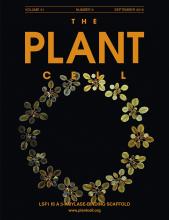
In the course of evolution, plants have developed mechanisms that orient their organs toward the incoming light. At the seedling stage, positive phototropism is mainly regulated by phototropin photoreceptors in blue and UV wavelengths. Contrasting with this, we report that UV RESISTANCE LOCUS8 (UVR8) serves as the predominant photoreceptor of UVB– induced phototropic responses in Arabidopsis (Arabidopsis thaliana) inflorescence stems. We examined the molecular mechanisms underlying this response and our findings support the Blaauw theory (Blaauw, 1919), suggesting rapid differential growth through unilateral photomorphogenic growth inhibition. UVR8-dependent UV-B light perception occurs mainly in the epidermis and cortex, but deeper tissues such as endodermis can also contribute. Within stems, a spatial difference of UVR8 signal causes a transcript and protein increase of transcription factors ELONGATED HYPOCOTYL5 (HY5) and its homolog HY5 HOMOLOG at the UV-B–exposed side. The irradiated side shows (1) strong activation of flavonoid synthesis genes and flavonoid accumulation; (2) increased gibberellin (GA)2-oxidase expression, diminished GA1 levels, and accumulation of the DELLA protein REPRESSOR OF GA1; and (3) increased expression of the auxin transport regulator PINOID, contributing to diminished auxin signaling. Together, the data suggest a mechanism of phototropin-independent inflorescence phototropism through multiple, locally UVR8-regulated hormone pathways . [Cerrar]
Thumbnail
Autor
Vanhaelewyn, Lucas;   Viczián, András;   Prinsen, Els;   Bernula, Péter;   Serrano, Alejandro Miguel;   Arana, María Veronica;   Ballaré, Carlos Luis;   Nagy, Ferenc;   Van Der Straeten, Dominique;   Vandenbussche, Filip;  
Fuente
The Plant Cell 31: 2070–2088 (Septiembre 2019)
Fecha
2019-09
Editorial
The American Society of Plant Biologists
ISSN
1040-4651
1532-298X
URI
http://hdl.handle.net/20.500.12123/7126
http://www.plantcell.org/content/31/9/2070
DOI
https://doi.org/10.1105/tpc.18.00929
Formato
pdf
Tipo de documento
artículo
Palabras Claves
Fisiología Vegetal; Plant Physiology; Fototropismo; Phototropism; Arabidopsis Thaliana; Fotorreceptores; Photoreceptors; UVR8;
Derechos de acceso
Restringido
Descargar
Compartir
  • Compartir
    Facebook Email Twitter Mendeley
Excepto donde se diga explicitamente, este item se publica bajo la siguiente descripción: Creative Commons Attribution-NonCommercial-ShareAlike 2.5 Unported (CC BY-NC-SA 2.5)
Metadatos
Mostrar el registro completo del ítem