
Ver ítem
- xmlui.general.dspace_homeCentros Regionales y EEAsCentro Regional Patagonia NorteEEA Alto ValleArtículos científicosxmlui.ArtifactBrowser.ItemViewer.trail
- Inicio
- Centros Regionales y EEAs
- Centro Regional Patagonia Norte
- EEA Alto Valle
- Artículos científicos
- Ver ítem
Trends in codling moth mating disruption programs in the pear orchards of Argentina
Resumen
Integrated pest and disease management has currently been directed more specifically towards the implementation of programs for the production of fruit with minimum pesticide residues. This is principally attributed to the increasing limitations of the most important European supermarket chains in relation to the residue levels and the number of active ingredients present in fresh fruits at the moment of being commercialized. In this framework it is
[ver mas...]
Integrated pest and disease management has currently been directed more specifically towards the implementation of programs for the production of fruit with minimum pesticide residues. This is principally attributed to the increasing limitations of the most important European supermarket chains in relation to the residue levels and the number of active ingredients present in fresh fruits at the moment of being commercialized. In this framework it is indispensable to know the pre-harvest interval (PHI) needed to avoid reaching the detectable limits of the commonly used pesticides. The design of sanitation programs becomes more complex when the protocol for fruit exports must be fulfilled to ensure the minimum probability of pest and/or diseases entering the import countries which are free from them. The new pest and disease management strategies are directed toward a lower number of pesticides applications. In order to attain this, it is recommended to apply the control practices during the first part of the crop season then eliminating sprays during the last part of the season (45 to 60 days before harvest). The pesticide application methods and the calculated volumes of application to be used determine the levels of final residues on the fruit. For this kind of strategy to be successful, besides the use of tools such as semiochemicals, cultural practices and biological control among others, it is essential to possess reliable information about the presence, abundance and the risk of attack through the different monitoring techniques and the models of prediction.
[Cerrar]

Autor
Descripción
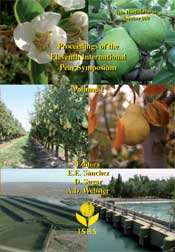
Trabajo presentado al XI International Pear Symposium, Argentina, 2010
Fuente
Acta Horticulturae 909 : 453-457 (Octubre 2011)
Fecha
2011-10-31
Editorial
ISHS
ISSN
0567-7572
2406-6168
2406-6168
ISBN
978-90-66055-04-9
Formato
pdf
Tipo de documento
artículo
Palabras Claves
Derechos de acceso
Restringido
Excepto donde se diga explicitamente, este item se publica bajo la siguiente descripción: Creative Commons Attribution-NonCommercial-ShareAlike 2.5 Unported (CC BY-NC-SA 2.5)


