
Ver ítem
- xmlui.general.dspace_homeCentros e Institutos de InvestigaciónCIAP. Centro de Investigaciones AgropecuariasInstituto de Investigación Animal del Chaco SemiáridoPresentaciones a Congresosxmlui.ArtifactBrowser.ItemViewer.trail
- Inicio
- Centros e Institutos de Investigación
- CIAP. Centro de Investigaciones Agropecuarias
- Instituto de Investigación Animal del Chaco Semiárido
- Presentaciones a Congresos
- Ver ítem
Condiciones medioambientales asociadas al estrés por calor y al bienestar animal en sistemas silvopastoriles de diferentes regiones de Argentina
Resumen
Dado la creciente frecuencia e intensidad de eventos de extremo calor, la producción animal en regiones cálidas enfrenta desafíos crecientes. En ese contexto, los sistemas silvopastoriles (SSP) emergen como una estrategia prometedora para mitigar estrés calórico y promover el bienestar animal. El objetivo de este estudio ha sido comparar y analizar variables microclimáticas, forrajeras y productivas entre SSP y pastoreo a cielo abierto (PACA) en tres
[ver mas...]
Dado la creciente frecuencia e intensidad de eventos de extremo calor, la producción animal en regiones cálidas enfrenta desafíos crecientes. En ese contexto, los sistemas silvopastoriles (SSP) emergen como una estrategia prometedora para mitigar estrés calórico y promover el bienestar animal. El objetivo de este estudio ha sido comparar y analizar variables microclimáticas, forrajeras y productivas entre SSP y pastoreo a cielo abierto (PACA) en tres regiones de la Argentina: Delta del Paraná, Tucumán y Misiones. En cada sitio, se relevaron parámetros ambientales (temperatura ambiente (TA) y de globo negro (TGN), humedad relativa y velocidad del viento) calculándose el Índice de Carga Térmica (ICT), comparándolos con el volumen y calidad de forraje y la Ganancia diaria de Peso en los sistemas de cada sitio. Los SSP consistentemente mostraron menores TGN menores valores de ICT en situaciones extremas en comparación a los PACA, especialmente en Misiones y Delta. Si bien la disponibilidad forrajera fue menor en SSP, su calidad (concentración de proteína bruta) fue mayor y el desempeño animal mejoró en todos los sitios evaluados, aunque sin diferenciación estadística. Los aprendizajes resaltan el rol clave de los SSP para regular el microclima, mejorar el confort animal y la concentración de proteína forrajera con efectos positivos sobre la GDP animal. Se concluye que los SSP, cuando son correctamente diseñados acorde a las condiciones locales, se tornan en una herramienta eficaz en pos del logro de sistemas productivos más resilientes.
[Cerrar]
Livestock production in warm regions faces increasing challenges due to the rising frequency and intensity of extreme heat events associated with climate change. In this context, silvopastoral systems (SPS) emerge as a promising strategy to mitigate heat stress and promote animal welfare. The objective of this study was to analyze and compare microclimatic, forage-related, and productive variables between Silvopastoral Systems (SPS) and open grazing
[ver mas...]
Livestock production in warm regions faces increasing challenges due to the rising frequency and intensity of extreme heat events associated with climate change. In this context, silvopastoral systems (SPS) emerge as a promising strategy to mitigate heat stress and promote animal welfare. The objective of this study was to analyze and compare microclimatic, forage-related, and productive variables between Silvopastoral Systems (SPS) and open grazing systems (OGS) across three regions of Argentina: Delta del Paraná, Tucumán, and Misiones. At each site, environmental variables were recorded (air temperature, black globe temperature, relative humidity, and wind speed), the Heat Load Index (HLI) was calculated, and forage indicators as well as average daily weight gain (ADG) in cattle were evaluated. SPS consistently showed lower black globe temperatures and reduced exposure to extreme HLI categories compared to OGS, with particularly notable
effects in Misiones and Delta. Although forage availability was lower in some SPS, forage quality improved—evidenced by higher crude protein content—and ADG was greater in all evaluated regions. These findings highlight the key role of tree cover in regulating the microclimate and improving thermal comfort andcrude protein content, with positive effects on animal performance. It is concluded that SPS, when designed and managed according to local conditions, represent an effective tool for advancing toward more resilient and sustainable livestock systems.
[Cerrar]

Autor
Zimerman, Maria;
Re, Paula;
Colcombet, Luis;
Moller, Adrian Renzo;
Loto, Mauro;
Solís, Viviana Noemí;
Fernández, Juan Ramón;
Lara, Javier Eduardo;
Rabello, Martín;
Viana, Alejandro;
Waidelich, Rebeca;
Fuente
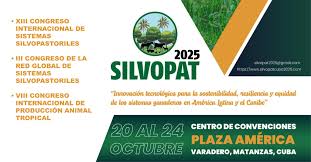
Actas XIII Congreso Internacional de Sistemas Silvopastoriles - III Congreso de la Red Global de Sistemas Silvopastoriles - VIII Congreso Internacional de Producción Animal Tropical, en Cuba del 20 al 24 de octubre de 2025, p. 136-143
Fecha
2025-10-20
Editorial
Instituto de Ciencia Animal del Ministerio de Educación Superior de la República de Cuba
ISBN
978-959-7171-88-1
Formato
pdf
Tipo de documento
documento de conferencia
Palabras Claves
Derechos de acceso
Abierto
Excepto donde se diga explicitamente, este item se publica bajo la siguiente descripción: Creative Commons Attribution-NonCommercial-ShareAlike 2.5 Unported (CC BY-NC-SA 2.5)


