
Ver ítem
- xmlui.general.dspace_homeCentros Regionales y EEAsCentro Regional Chaco - FormosaEEA Las BreñasArtículos científicosxmlui.ArtifactBrowser.ItemViewer.trail
- Inicio
- Centros Regionales y EEAs
- Centro Regional Chaco - Formosa
- EEA Las Breñas
- Artículos científicos
- Ver ítem
Reproductive strategy of overwintering Dalbulus maidis (Hemiptera: Cicadellidae) in subtropical areas: neither temperature nor photoperiod, only corn triggers oviposition
Resumen
BACKGROUND: The corn leafhopper Dalbulus maidis, a key vector of corn stunt disease, poses a major threat to corn production across the Americas. In subtropical South America, females overwinter as active adults despite the absence of host plants. This study explored, for the first time, the reproductive status and adaptive strategies of D. maidis females overwintering in Tucumán, Argentina.
RESULTS: In field, seasonal polyphenism was evident, with
[ver mas...]
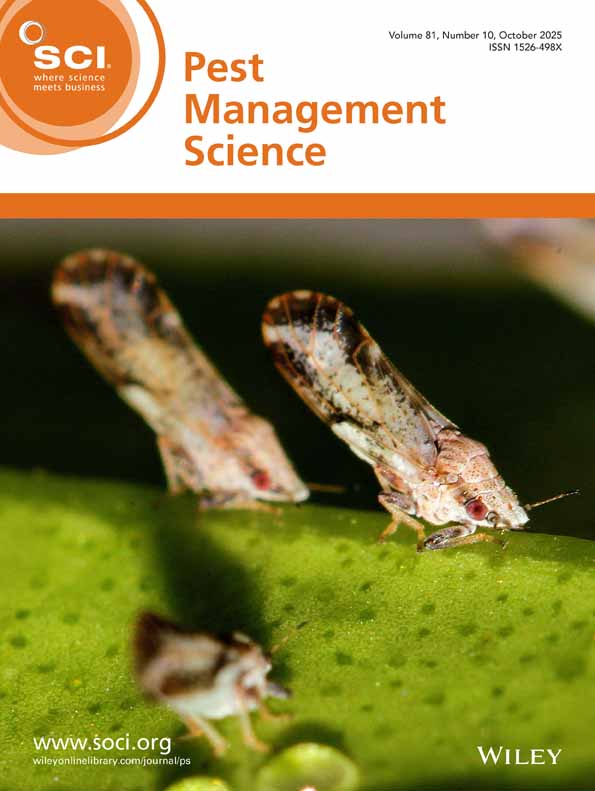
BACKGROUND: The corn leafhopper Dalbulus maidis, a key vector of corn stunt disease, poses a major threat to corn production across the Americas. In subtropical South America, females overwinter as active adults despite the absence of host plants. This study explored, for the first time, the reproductive status and adaptive strategies of D. maidis females overwintering in Tucumán, Argentina.
RESULTS: In field, seasonal polyphenism was evident, with melanized females predominating in winter, likely enhancing cold tolerance. Females survive winter with inactive but fertilized ovaries, indicating a state of reproductive quiescence. Ovarian activation and egg-laying are triggered by host plant availability rather than environmental cues such as temperature or photoperiod. Nonetheless, temperature and photoperiod significantly influence the polyphenism of first-generation offspring – longer days and higher temperatures yield larger, lighter individuals, while colder, shorter days produce smaller, darker ones. Additionally, oviposition occurs almost exclusively during daylight hours.
CONCLUSION: The observed female-biased sex ratio and polyphenic variations suggest a combination of physiological and behavioral adaptations for winter survival. In overwintering females of the vector, access to corn plants is the key trigger for ovarian activation and the initiation of egg-laying. Despite not quantifying sperm load, overwintered females maintained > 80% fertility for over 2 weeks without male presence once corn was accessible. These findings underscore the importance of managing volunteer corn and standardizing early sowing to mitigate early infestations and economic losses due to D. maidis outbreaks in late-planted corn fields.
[Cerrar]

Autor
Van Nieuwenhove, Guido Alejandro;
Bezdjian, Laura Patricia;
Van Nieuwenhove, Carina Paola;
Coll Aráoz, María Victoria;
Casuso, Violeta Macarena;
Virla, Eduardo Gabriel;
Fuente
Pest Management Science : 1-11 (First published: 12 September 2025)
Fecha
2025-09
Editorial
Wiley
ISSN
1526-498X
1526-4998
1526-4998
Formato
pdf
Tipo de documento
artículo
Palabras Claves
Derechos de acceso
Restringido
Excepto donde se diga explicitamente, este item se publica bajo la siguiente descripción: Creative Commons Attribution-NonCommercial-ShareAlike 2.5 Unported (CC BY-NC-SA 2.5)


