
Ver ítem
- xmlui.general.dspace_homeCentros e Institutos de InvestigaciónCICVyA. Centro de Investigación en Ciencias Veterinarias y AgronómicasInstituto de GenéticaArtículos científicosxmlui.ArtifactBrowser.ItemViewer.trail
- Inicio
- Centros e Institutos de Investigación
- CICVyA. Centro de Investigación en Ciencias Veterinarias y Agronómicas
- Instituto de Genética
- Artículos científicos
- Ver ítem
When african and european lineages meet: The genetic landscape of honey bees in Argentina
Resumen
Argentina has a complex and diverse landscape of honeybee (Apis mellifera sp.) populations shaped by historic introductions and hybridization between Africanized (AHB) and European (EHB) lineages. While a latitudinal cline of Africanization has been
documented, the adaptive consequences of this genetic admixture and its implications for local beekeeping practices remain poorly understood. In this study, we provide a more in-depth analysis of Argentine
[ver mas...]
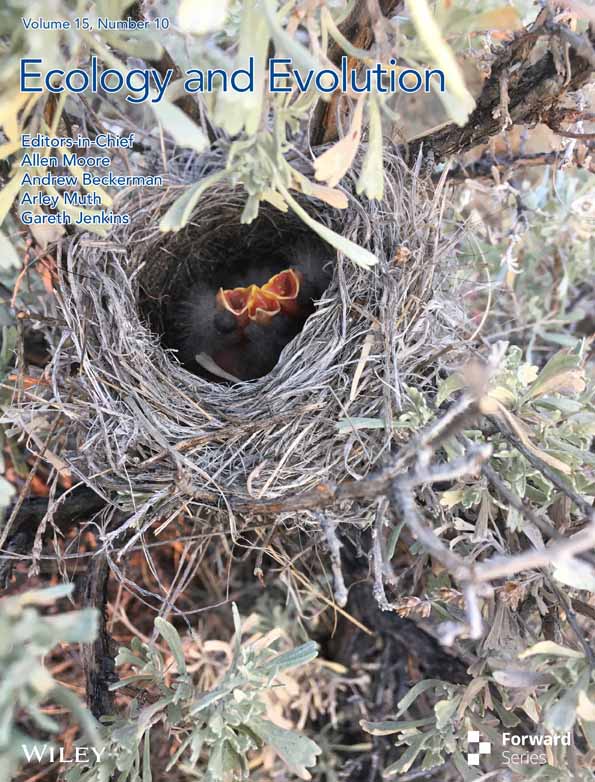
Argentina has a complex and diverse landscape of honeybee (Apis mellifera sp.) populations shaped by historic introductions and hybridization between Africanized (AHB) and European (EHB) lineages. While a latitudinal cline of Africanization has been
documented, the adaptive consequences of this genetic admixture and its implications for local beekeeping practices remain poorly understood. In this study, we provide a more in-depth analysis of Argentine honeybee populations using recently published data from a panel of 272 SNP markers across five ecoregions to: (1) quantify how ancestry proportion (African A, European C/M) varies along geographic gradients, (2) assess whether ecoregion boundaries influence population structure, and (3) evaluate
the potential trade-offs between AHB and EHB ancestry in hybrid genomes. Our results confirm a strong latitudinal pattern of Africanization but reveal novel complexity, with C-lineage ancestry inversely correlated with A-lineage contributions while Mlineage ancestry remains independent. We also detected trace contributions from the O lineage (Middle Eastern), highlighting Argentina's complex admixture history. Despite Argentina's diverse ecoregions, we find limited evidence for ecotype-specific differentiation, suggesting gene flow may outweigh local adaptation—though sampling limitations warrant caution. By linking
genetic patterns to apicultural relevance (e.g., AHB's northward expansion and hybridization zones), this study provides a framework for conserving genetic diversity and managing hive productivity across environmental gradients. Further genome-wide
analyses are needed to disentangle adaptive traits in this understudied yet economically critical pollinator system.
[Cerrar]

Autor
Avalos, Arian;
Scannapieco, Alejandra Carla;
Monmany Garzia, A. Carolina;
Donthu, Ravi Kiran;
Marcelino, José;
Giordano, Rosanna;
Giray, Tugrul;
Galindo Cardona, Alberto;
Fuente
Ecology and Evolution 15 (10) : e72233 (First published: 28 september 2025)
Fecha
2025-09-28
Editorial
Wiley
ISSN
2045-7758 (online)
2045-7758 (impreso)
2045-7758 (impreso)
Formato
pdf
Tipo de documento
artículo
Palabras Claves
Derechos de acceso
Abierto
Excepto donde se diga explicitamente, este item se publica bajo la siguiente descripción: Creative Commons Attribution-NonCommercial-ShareAlike 2.5 Unported (CC BY-NC-SA 2.5)


