
Ver ítem
- xmlui.general.dspace_homeCentros Regionales y EEAsCentro Regional Buenos Aires SurEEA Cesareo NaredoArtículos científicosxmlui.ArtifactBrowser.ItemViewer.trail
- Inicio
- Centros Regionales y EEAs
- Centro Regional Buenos Aires Sur
- EEA Cesareo Naredo
- Artículos científicos
- Ver ítem
Disentangling biodiversity–ecosystem functioning relationship mechanisms in woody-herbaceous communities: The importance of facilitation
Resumen
The functional consequences of life form coexistence in mixed woody-herbaceous communities remain a key question within the biodiversity–ecosystem functioning (BEF) framework. Our aim was to test three models proposed for the relationship between vegetation physiognomy and ecosystem functioning in drylands. Furthermore, these natural systems provide an opportunity to disentangle the ecological mechanisms driving biomass production, which have often been
[ver mas...]
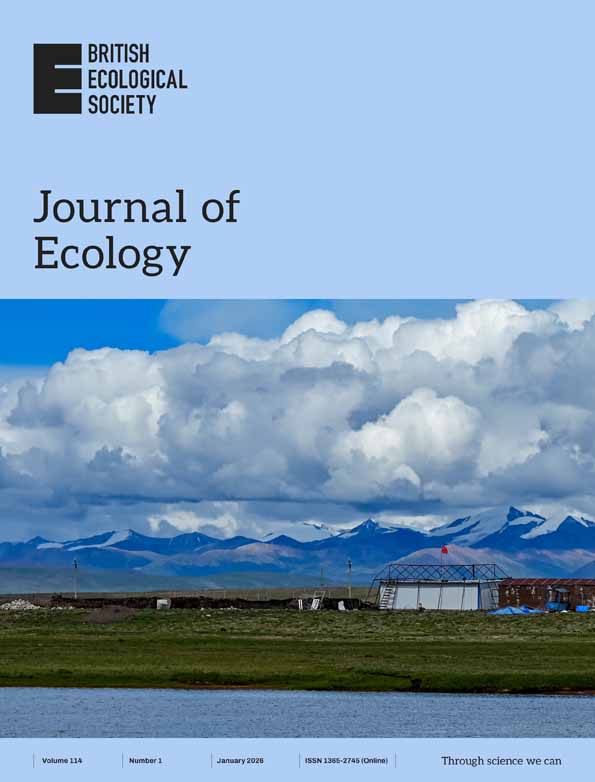
The functional consequences of life form coexistence in mixed woody-herbaceous communities remain a key question within the biodiversity–ecosystem functioning (BEF) framework. Our aim was to test three models proposed for the relationship between vegetation physiognomy and ecosystem functioning in drylands. Furthermore, these natural systems provide an opportunity to disentangle the ecological mechanisms driving biomass production, which have often been oversimplified by using species richness as a proxy for diversity in randomly assembled artificial communities.
We conducted a field-based removal experiment in a Patagonian shrub-grass steppe, creating experimental communities dominated by a single life form (i.e. grasses or shrubs) and comparing them to mixed communities. We estimated green biomass at the peak of the growing season as a proxy for above-ground net primary production (ANPP; g·m−2·year−1) in three censuses conducted during the first 5 years after removals. Furthermore, we applied an ecological adaptation of the Price equation to decompose ANPP differences into components that reveal the mechanisms driving the response.
We found that (i) ANPP of shrubs decreased when coexisting with grasses; (ii) ANPP of grasses increased when coexisting with shrubs; (iii) total ANPP was maximized at intermediate densities of life forms.
Our analysis revealed that life form coexistence maximizes ANPP through a positive effect exerted by shrubs on grasses, rather than through a more exhaustive use of the limiting resource (i.e. water).
Synthesis. The relationship between life form dominance and ANPP remains an unresolved question in woody-herbaceous communities. More than 20 years ago, three alternative models were proposed, yet they remain unchallenged. Here, we provide evidence supporting the optimum model, which predicts higher ANPP when herbaceous and woody species co-dominate the community. Although BEF studies have identified niche complementarity as the main mechanism explaining this pattern, our results suggest that facilitation plays a more important role in the functioning of the Patagonian shrub-grass steppe. By incorporating community assembly processes into ecosystem functioning research, we provide empirical evidence that positive interactions are crucial for ecosystem functioning in mixed woody-herbaceous communities.
[Cerrar]

Autor
Nasta, Lautaro L.;
Aguiar, Martín Roberto;
Graff, Barbara Pamela;
Fuente
Journal of Ecology 114 (1) : e70240. (January 2026)
Fecha
2026-01
Editorial
Wiley
ISSN
0022-0477
1365-2745
1365-2745
Formato
pdf
Tipo de documento
artículo
Palabras Claves
Derechos de acceso
Restringido
Excepto donde se diga explicitamente, este item se publica bajo la siguiente descripción: Creative Commons Attribution-NonCommercial-ShareAlike 2.5 Unported (CC BY-NC-SA 2.5)


