
Facebook
Twitter
YouTube
Instagram
    • español
    • English
  • Contacto
  • English 
    • español
    • English
  • Login
AboutAuthorsTitlesSubjectsCollectionsCommunities☰
JavaScript is disabled for your browser. Some features of this site may not work without it.
View Item 
    xmlui.general.dspace_homeCentros e Institutos de InvestigaciónCICVyA. Centro de Investigación en Ciencias Veterinarias y AgronómicasInstituto de BiotecnologíaArtículos científicosxmlui.ArtifactBrowser.ItemViewer.trail
  • DSpace Home
  • Centros e Institutos de Investigación
  • CICVyA. Centro de Investigación en Ciencias Veterinarias y Agronómicas
  • Instituto de Biotecnología
  • Artículos científicos
  • View Item

Silencing of the tomato Sugar Partitioning Affecting protein (SPA) modifies sink strength through a shift in leaf sugar metabolism

Abstract
Limitations in our understanding about the mechanisms that underlie source-sink assimilate partitioning are increasingly becoming a major hurdle for crop yield enhancement via metabolic engineering. By means of a comprehensive approach, this work reports the functional characterization of a DnaJ chaperone related-protein (named as SPA; sugar partition-affecting) that is involved in assimilate partitioning in tomato plants. SPA protein was found to be [ver mas...]
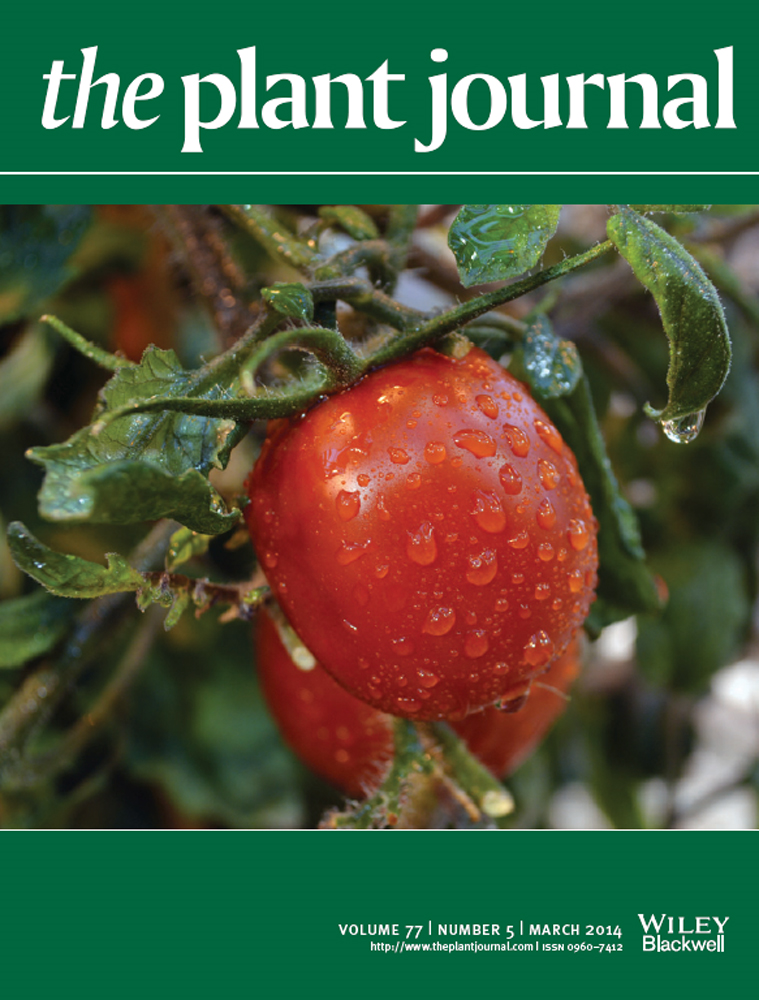
Limitations in our understanding about the mechanisms that underlie source-sink assimilate partitioning are increasingly becoming a major hurdle for crop yield enhancement via metabolic engineering. By means of a comprehensive approach, this work reports the functional characterization of a DnaJ chaperone related-protein (named as SPA; sugar partition-affecting) that is involved in assimilate partitioning in tomato plants. SPA protein was found to be targeted to the chloroplast thylakoid membranes. SPA-RNAi tomato plants produced more and heavier fruits compared with controls, thus resulting in a considerable increment in harvest index. The transgenic plants also displayed increased pigment levels and reduced sucrose, glucose and fructose contents in leaves. Detailed metabolic and enzymatic activities analyses showed that sugar phosphate intermediates were increased while the activity of phosphoglucomutase, sugar kinases and invertases was reduced in the photosynthetic organs of the silenced plants. These changes would be anticipated to promote carbon export from foliar tissues. The combined results suggested that the tomato SPA protein plays an important role in plastid metabolism and mediates the source-sink relationships by affecting the rate of carbon translocation to fruits. [Cerrar]
Thumbnail
Author
Bermudez Salazar, Luisa;   de Godoy, Fabiana;   Baldet, Pierre;   Demarco, Diego;   Osorio, Sonia;   Quadrana, Leandro Daniel;   Almeida de Souza, Juliana Beatriz;   Asis, Ramón;   Gibon, Yves;   Fernie, Alisdair R.;   Rossi, Maria Magdalena;   Carrari, Fernando;  
Fuente
Plant journal 77 (5) : 676-687. (March 2014)
Date
2014-03
Editorial
Wiley; Society for Experimental Biology
ISSN
1365-313X
URI
http://hdl.handle.net/20.500.12123/4750
https://onlinelibrary.wiley.com/doi/full/10.1111/tpj.12418
DOI
https://doi.org/10.1111/tpj.12418
Formato
pdf
Tipo de documento
artículo
Palabras Claves
Tomate; Tomatoes; Solanum Lycopersicum; Azúcar; Sugar; Metabolismo; Metabolism; Chloroplasts; Cloroplasto; Small Plastidial Protein; Source-sink Partitioning;
Derechos de acceso
Restringido
Descargar
Compartir
  • Compartir
    Facebook Email Twitter Mendeley
Excepto donde se diga explicitamente, este item se publica bajo la siguiente descripción: Creative Commons Attribution-NonCommercial-ShareAlike 2.5 Unported (CC BY-NC-SA 2.5)
Metadata
Show full item record