
Facebook
Twitter
YouTube
Instagram
    • español
    • English
  • Contacto
  • English 
    • español
    • English
  • Login
AboutAuthorsTitlesSubjectsCollectionsCommunities☰
JavaScript is disabled for your browser. Some features of this site may not work without it.
View Item 
    xmlui.general.dspace_homeCentros e Institutos de InvestigaciónCICVyA. Centro de Investigación en Ciencias Veterinarias y AgronómicasInstituto de BiotecnologíaArtículos científicosxmlui.ArtifactBrowser.ItemViewer.trail
  • DSpace Home
  • Centros e Institutos de Investigación
  • CICVyA. Centro de Investigación en Ciencias Veterinarias y Agronómicas
  • Instituto de Biotecnología
  • Artículos científicos
  • View Item

Citrus psorosis virus 24K protein interacts with citrus miRNA precursors, affects their processing and subsequent miRNA accumulation and target expression

Abstract
Sweet orange (Citrus sinensis), one of the most important fruit crops worldwide, may suffer from disease symptoms induced by virus infections, thus resulting in dramatic economic losses. Here, we show that the infection of sweet orange plants with two isolates of Citrus psorosis virus (CPsV) expressing different symptomatology alters the accumulation of a set of endogenous microRNAs (miRNAs). Within these miRNAs, miR156, miR167 and miR171 were the most [ver mas...]
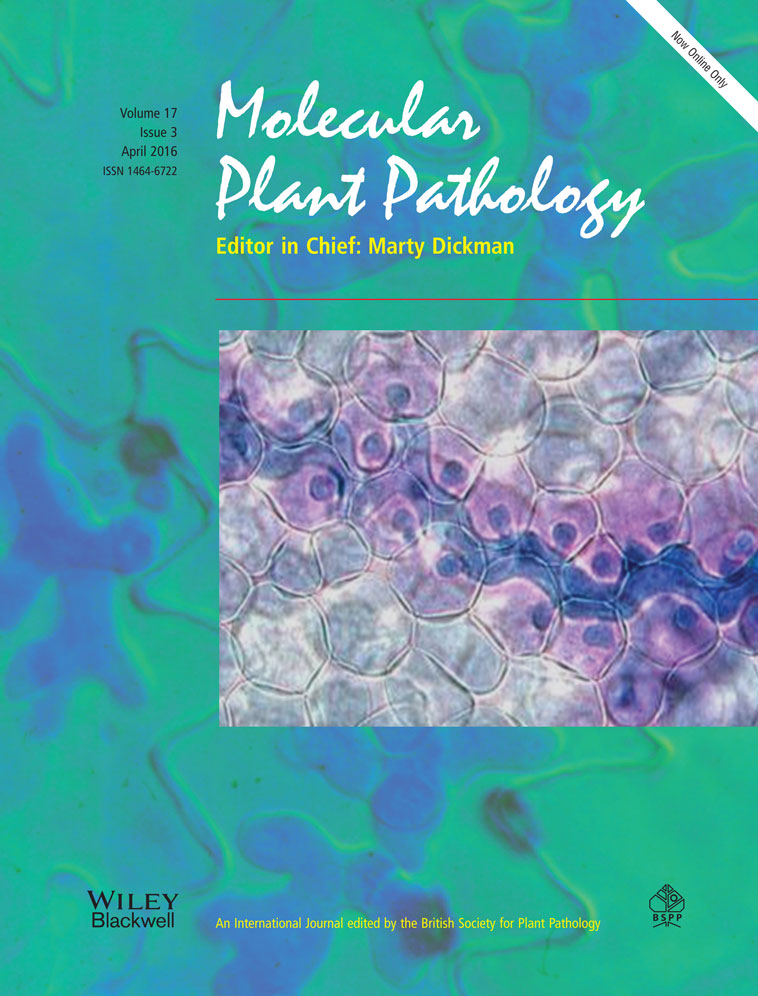
Sweet orange (Citrus sinensis), one of the most important fruit crops worldwide, may suffer from disease symptoms induced by virus infections, thus resulting in dramatic economic losses. Here, we show that the infection of sweet orange plants with two isolates of Citrus psorosis virus (CPsV) expressing different symptomatology alters the accumulation of a set of endogenous microRNAs (miRNAs). Within these miRNAs, miR156, miR167 and miR171 were the most down-regulated, with almost a three-fold reduction in infected samples. This down-regulation led to a concomitant up-regulation of some of their targets, such as Squamosa promoter-binding protein-like 9 and 13, as well as Scarecrow-like 6. The processing of miRNA precursors, pre-miR156 and premiR171, in sweet orange seems to be affected by the virus. For instance, virus infection increases the level of unprocessed precursors, which is accompanied by a concomitant decrease in mature species accumulation. miR156a primary transcript accumulation remained unaltered, thus strongly suggesting a processing deregulation for this transcript. The co-immunoprecipitation of viral 24K protein with pre-miR156a or pre-miR171a suggests that the alteration in the processing of these precursors might be caused by a direct or indirect interaction with this particular viral protein. This result is also consistent with the nuclear localization of both miRNA precursors and the CPsV 24K protein. This study contributes to the understanding of the manner in which a virus can alter host regulatory mechanisms, particularly miRNA biogenesis and target expression. [Cerrar]
Thumbnail
Author
Reyes, Carina Andrea;   Ocolotobiche, Eliana Evelina;   Marmisollé, Facundo E.;   Robles Luna, Gabriel;   Bazzini, Ariel Alejandro;   Asurmendi, Sebastian;   García, María Laura;  
Fuente
Molecular plant pathology 17 (3) : 317-329. (2016 Apr.)
Date
2016-04
ISSN
1464-6722
URI
http://hdl.handle.net/20.500.12123/2166
https://onlinelibrary.wiley.com/doi/full/10.1111/mpp.12282
Formato
pdf
Tipo de documento
artículo
Palabras Claves
Virus de las Plantas; Citrus; ARN; Naranja Dulce; Sweet Oranges; RNA; Plant Viruses; Virus de la Psoriasis de los Cítricos; Ophiovirus;
Derechos de acceso
Restringido
Descargar
Compartir
  • Compartir
    Facebook Email Twitter Mendeley
Excepto donde se diga explicitamente, este item se publica bajo la siguiente descripción: Creative Commons Attribution-NonCommercial-ShareAlike 2.5 Unported (CC BY-NC-SA 2.5)
Metadata
Show full item record