
Facebook
Twitter
YouTube
Instagram
    • español
    • English
  • Contacto
  • English 
    • español
    • English
  • Login
AboutAuthorsTitlesSubjectsCollectionsCommunities☰
JavaScript is disabled for your browser. Some features of this site may not work without it.
View Item 
    xmlui.general.dspace_homeCentros e Institutos de InvestigaciónCICVyA. Centro de Investigación en Ciencias Veterinarias y AgronómicasInstituto de GenéticaArtículos científicosxmlui.ArtifactBrowser.ItemViewer.trail
  • DSpace Home
  • Centros e Institutos de Investigación
  • CICVyA. Centro de Investigación en Ciencias Veterinarias y Agronómicas
  • Instituto de Genética
  • Artículos científicos
  • View Item

Dependence of egg hatching on Wolbachia density in a parthenogenetic weevil revealed by antibiotic treatment

Abstract
Naupactini is a tribe of Neotropical broad‐nosed weevils highly diverse in South America. This group includes several parthenogenetic species, some of them harmful for agriculture and invasive around the world. Although some hypotheses based on polyploidy and hybridization have been proposed to explain the origin of parthenogenesis in weevils, the infection with the bacterium Wolbachia pipientis may be involved in the origin of parthenogenetic [ver mas...]
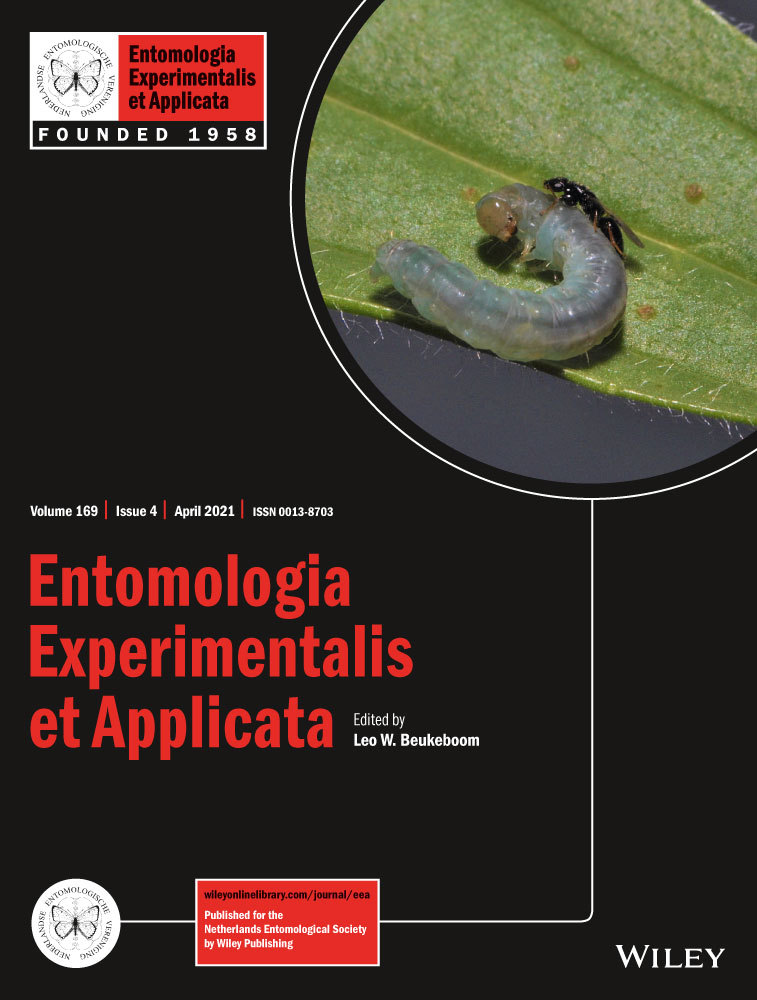
Naupactini is a tribe of Neotropical broad‐nosed weevils highly diverse in South America. This group includes several parthenogenetic species, some of them harmful for agriculture and invasive around the world. Although some hypotheses based on polyploidy and hybridization have been proposed to explain the origin of parthenogenesis in weevils, the infection with the bacterium Wolbachia pipientis may be involved in the origin of parthenogenetic reproduction of some species. In this contribution, we studied the role of Wolbachia in the reproductive biology of Pantomorus postfasciatus Hustache (Coleoptera: Curculionidae) through a curing experiment using tetracycline. This weevil has a mixed mode of reproduction including sexual and parthenogenetic populations. Exposure to an antibiotic did not affect fecundity, but did reduce egg hatching in comparison with untreated individuals. Consequently, we inferred that Wolbachia most probably takes part in the reproduction of P. postfasciatus, either by exerting nutritive functions in oogenesis necessary for egg hatching, or by induction of thelytokous parthenogenesis. Although infection was not totally cured, Wolbachia load was significantly lower in treated than in control females. Thereby, we hypothesize that a minimum threshold density of Wolbachia is required for weevil reproduction. We conclude that all analyses support a role of Wolbachia in P. postfasciatus reproduction. [Cerrar]
Thumbnail
Author
Rodriguero, Marcela Silvina;   Scannapieco, Alejandra Carla;   Monti, Daniela S.;   Chifflet, Lucila;   Elias-Costa, Agustín J.;   Lanteri, Analía A.;   Confalonieri, Viviana A.;  
Fuente
Entomologia Experimentalis et Applicata 169 (4) : 384-392 (Abril 2021)
Date
2021-04
Editorial
Wiley
ISSN
1570-7458
URI
http://hdl.handle.net/20.500.12123/9174
https://onlinelibrary.wiley.com/doi/10.1111/eea.13019
DOI
https://doi.org/10.1111/eea.13019
Formato
pdf
Tipo de documento
artículo
Palabras Claves
Curculionidae; Wolbachia pipientis; Parthenogenesis; Partenogénesis; Tetracyclines; Tetraciclina; Symbiosis; Simbiosis; Oogenesis; Oogénesis; Coleoptera; Antibiotics; Antibióticos; Hatching; Eclosión; Pantomorus postfasciatus; Naupactini;
Derechos de acceso
Restringido
Descargar
Compartir
  • Compartir
    Facebook Email Twitter Mendeley
Excepto donde se diga explicitamente, este item se publica bajo la siguiente descripción: Creative Commons Attribution-NonCommercial-ShareAlike 2.5 Unported (CC BY-NC-SA 2.5)
Metadata
Show full item record