
Facebook
Twitter
YouTube
Instagram
    • español
    • English
  • Contacto
  • English 
    • español
    • English
  • Login
AboutAuthorsTitlesSubjectsCollectionsCommunities☰
JavaScript is disabled for your browser. Some features of this site may not work without it.
View Item 
    xmlui.general.dspace_homeCentros Regionales y EEAsCentro Regional Buenos Aires SurEEA BarrowArtículos científicosxmlui.ArtifactBrowser.ItemViewer.trail
  • DSpace Home
  • Centros Regionales y EEAs
  • Centro Regional Buenos Aires Sur
  • EEA Barrow
  • Artículos científicos
  • View Item

Developmental environment influences activity levels in a montane rodent, Phyllotis xanthopygus

Abstract
Ambient temperature and thermal variability play a crucial role in diverse aspects of organisms’ biology. In the current context of climate change, it is critical to understand how temperature impacts traits that could affect fitness. In Phyllotis xanthopygus, a small altricial rodent inhabiting an altitudinal gradient in the Andes Mountains of Argentina, the behavioral response to temperature varies between populations from different altitudes. Animals [ver mas...]
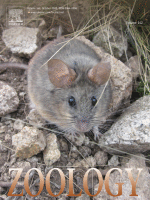
Ambient temperature and thermal variability play a crucial role in diverse aspects of organisms’ biology. In the current context of climate change, it is critical to understand how temperature impacts traits that could affect fitness. In Phyllotis xanthopygus, a small altricial rodent inhabiting an altitudinal gradient in the Andes Mountains of Argentina, the behavioral response to temperature varies between populations from different altitudes. Animals from high altitude (cold environment) reduce their activity rate at high temperatures, in contrast to animals from low altitude (relatively warmer environment). The goal of this study was to unveil the mechanism underlying such intraspecific behavioral variability in P. xanthopygus. We characterized activity rates under different thermal treatments both for wild-reared and lab-reared animals. As we expected, the intraspecific variability shown by animals raised at different altitudes in the field disappeared in animals raised under homogenous conditions in the laboratory. Our results are indicative of ontogenetic plasticity in P. xanthopygus and suggest that the behavioral versatility of adult individuals to deal with thermal challenges is shaped by the range of environmental conditions experienced during their early life. This adds to the list of features that modulate the biological performance of individuals and could influence the relative vulnerability of populations inhabiting different elevations under the global disturbance of climate change. [Cerrar]
Thumbnail
Author
Ruperto, Emmanuel Fabián;   Taraborelli, Paula Andrea;   Menéndez, Josefina;   Sassi, Paola Lorena;  
Fuente
Zoology 142 : 125818 (October 2020)
Date
2020-10
Editorial
Elsevier
ISSN
0944-2006
URI
http://hdl.handle.net/20.500.12123/13887
https://www.sciencedirect.com/science/article/abs/pii/S0944200620300775
DOI
https://doi.org/10.1016/j.zool.2020.125818
Formato
pdf
Tipo de documento
artículo
Palabras Claves
Roedores; Rodents; Medio Ambiente; Environment; Temperatura Ambiental; Environmental Temperature; Comportamiento Animal; Animal Behaviour; Cambio Climático; Climate Change; Phyllotis xanthopygus;
Derechos de acceso
Restringido
Descargar
Compartir
  • Compartir
    Facebook Email Twitter Mendeley
Excepto donde se diga explicitamente, este item se publica bajo la siguiente descripción: Creative Commons Attribution-NonCommercial-ShareAlike 2.5 Unported (CC BY-NC-SA 2.5)
Metadata
Show full item record